Who Killed The Brief?
A campaign brief had been killed off before it could launch. A room of Brussels communicators had two hours to find out how — and whether it could be revived.
A group of unsuspecting participants were handed an unmarked envelope each and given the task to resurrect a failed campaign. The rest of the night was anything but predictable.
Brussels has no shortage of professional development and networking sessions, but it had never seen one like this! For the first time, Social Capital held a murder mystery format for one of our workshops. But not a murder mystery as you know it. The victim was a campaign brief that had effectively been killed off before it was able to be launched.
What happened
Who killed the brief?
The format
The ambition was to teach the skills that matter in Brussels — negotiation, influence, strategy, creativity, diplomacy — through engaging in a simulated professional scenario. Instead of sitting through a panel about these skills, they had to use them to solve a life-like challenge. Each attendee was assigned a role representing an organisation within a typical Brussels coalition arrangement: institutional sponsors holding all the cards; agencies each owning a single piece of the campaign; and a wider circle of industry stakeholders, each with their own aim. Their role description was accompanied by a dossier of information relevant to their role in a fictitious campaign that had been commissioned. The evening's main protagonist, Bisera Savoska in the role of Secretary-General, delivered instructions to share and compare information from the briefing packs, to investigate how the brief died, and to analyse if and how it could be revived.
The investigation
There was no script to follow once the simulation began. Sector clusters formed first: institutional sponsors grouped together, and agencies found their opposite numbers, while the industry group strategised their attack plan. Then the real work started: working out, person by person, where and how the brief had actually broken down. Pieces of the puzzle were gradually placed together to create a clear picture of what exactly had happened to the brief. From governance failures to creative indecision, the causes were real and sometimes too familiar. Once this was uncovered, the task was then to identify the areas for improvement in order to resurrect the brief.
The conclusion
The final element of the evening was a pitch presentation. In an attempt to collate and package all the discussions of the night, an alternative vision was presented to convince the Secretary-General that the brief could indeed be saved successfully. By 21:30, the room had its answer, and it wasn't a happy one. The last-minute rush by the self-selected pitch team to save the brief in the final stretch ultimately failed. The verdict: the brief was officially dead. Just as Brussels campaigns often fail, the room spent two hours discovering exactly how easily it can happen.
Unexpected connections
Participants manoeuvred through the space in an attempt to eavesdrop on conversations, create ad hoc groupings to address burning topics, and even pull aside their targets to formalise alliances – sometimes with unlikely partners.
Key insights
What we learned
There's more than one way to do networking and learning
The Brussels playbook on events is well known. Organisations rarely venture far from the tried-and-true formats. The courage to do something different is often missing. That's why doing something different is so important, and why this event was such a success. Participants were able to build connections and skills by doing something fun, practical and unusual.
Passion for communications lives on long after the workdays ends
Despite everyone coming after a full day of work, every participant took on their role with 100% enthusiasm and dedication. There was not a dull moment during the evening. It showed how passionate we are as communications professionals about our craft that we would voluntarily give up our free time to keep building skills and expertise outside of work hours.
Personality counts
Each person brought so much individuality to their role: the Commission representative was unquestionably forthcoming about what they needed; the industry representatives matched that assertiveness; while the lead agency attempted to provide structure for negotiations. The asymmetry between the different approaches was not merely a product of what was in the brief, but was also based on what each person brought from their own personal and professional toolkit. In this way, people could test their skills under pressure and learn from others.
Uncertainty is uncomfortable
No matter how confident we might be in our daily work lives, we all have one thing in common: a lack of clarity puts us to the test. This is how the participants felt at the beginning of the evening when taking on a foreign identity and sifting through new information. It takes time to become familiar in a new environment. However, everyone showed incredible resilience in dealing with the uncertainty.
The result was not foreshadowed
Despite most people's expectations, there was no predetermined outcome for this murder mystery. Unlike a game of Cluedo with only one possible result, it was very much a choose-your-own-adventure scenario, based on the direction chosen by the group itself. Essentially, the experience was the lesson. Attendees were left to draw their own conclusions about how campaigns actually fail and how they can prevent this outcome in their real work.
Quote that captured the night
“There's nothing quite like having to improv a sweaty brand identity pitch on the spot. An unforgettable game of teamwork and skulduggery!”
Member stories
What attendees said
Who Killed The Brief? attendee
Communications professional
“I appreciated the challenge of the role I was given and being put on the hot spot. I liked the chaos which was representative of the job.”
Who Killed The Brief? attendee
Communications professional
“I don't think I've ever laughed so much at a networking event. It was a lot of fun.”
Who Killed The Brief? attendee
Communications professional
“We've had intense discussions with one another and yet don't know anything about each other. The next day we were all very curious on LinkedIn to unveil the truth about one another. Loved it. It's kind of a match with the spirit of Social Capital.”
Been there? Share your feedback and you might be featured here.
Venue
Why Full Circle Brussels works for this
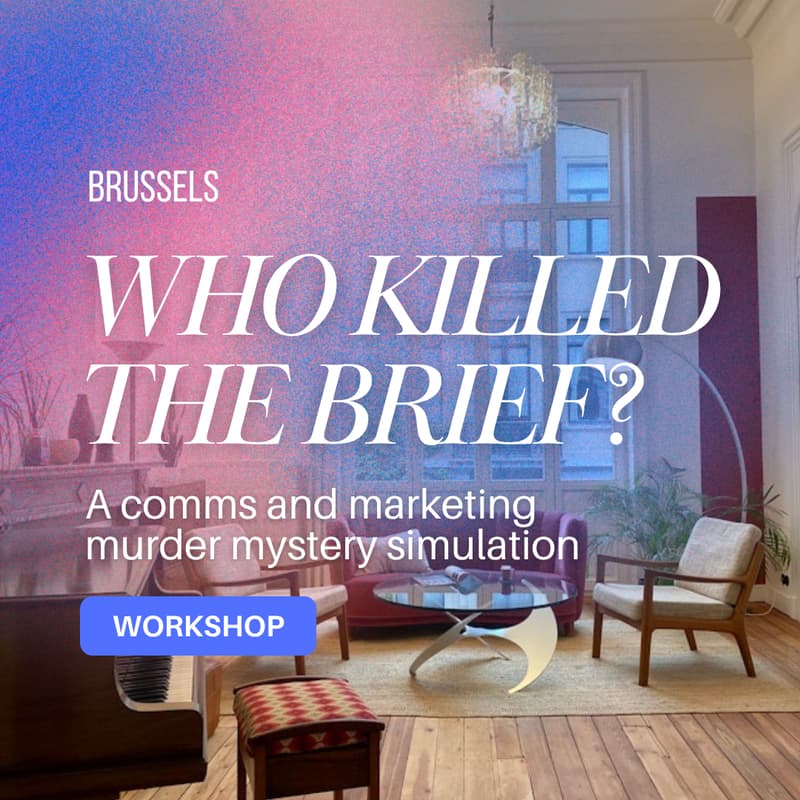
The Full Circle's Members' Lounge gave the evening an intimate and suitably mysterious feel, with different room to circulate, corners for private deals, and proximity to the bar to ease building tensions. The negotiations reached a crescendo at various points in the night, with individuals taking control in an attempt to find agreement among the diverse group of stakeholders in the room.
Address
Chaussée de Vleurgat 89, 1050 Ixelles, Brussels
Don't miss out
Join us at the next one
Social Capital hosts events every month. Aperos, workshops, creative walks. Free for members.